News - News Releases 2026
24/04/2026 11:08:00
Central Bank of Malta launches its 2025 Annual Report
The Central Bank of Malta formally launched its 2025 Annual Report during an event held at its premises in Valletta on 24 April 2026. The event featured addresses by the Governor, Mr Alexander Demarco, the Chief Economist, Dr Aaron Grech, Deputy Governor for Financial Stability, Mr Oliver Bonello, and Deputy Governor for Monetary Policy, Ms Rita Schembri.
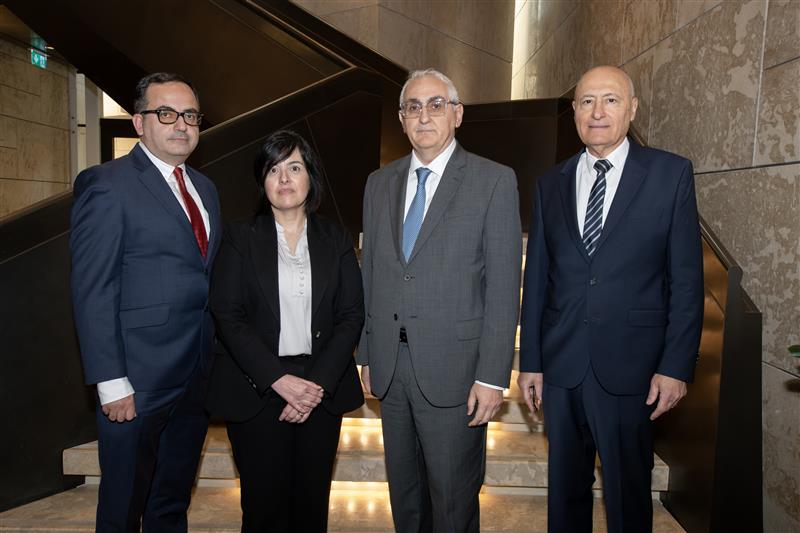
From left: Chief Economist Dr Aaron G. Grech, Deputy Governor Rita Schembri,
Governor Alexander Demarco and Deputy Governor Oliver Bonello
Photo: Melvin Bugeja/Central Bank of Malta
The 2025 Annual Report presents a comprehensive and detailed assessment of the principal economic, monetary, and financial developments in Malta, set within the broader international context. It also includes an account of organisational developments, together with the Bank's audited financial statements.
In his address, Governor Mr Alexander Demarco provided an overview of developments in the euro area economy and the conduct of monetary policy. He noted that the euro area economy showed increasing signs of stabilisation as the year progressed in spite of heightened geopolitical uncertainty, while inflationary pressures continued to recede. As successive projections indicated that inflation was moving sustainably towards the European Central Bank's (ECB) 2% medium‑term target, the Governing Council lowered the three key ECB interest rates by a cumulative 100 basis points in the first half of the year, bringing the deposit facility rate to 2.00% by June. At the same time, the Eurosystem balance sheet continued to contract as securities purchased for monetary policy purposes were no longer reinvested, while banks made limited use of standard refinancing operations. Overall, monetary policy was in a good place in 2025, with inflation close to target.
Against exceptionally high geopolitical and trade‑related uncertainty, the Governing Council followed a data‑dependent, meeting‑by‑meeting approach. This approach allows it to respond flexibly to evolving conditions, including those arising from the conflict in the Middle East.
The Chief Economist, Dr Aaron Grech, stated that economic growth in Malta moderated over the year but remained robust and well above that of the euro area. Growth was underpinned by both domestic demand and exports. Inflation stayed contained, stabilising at 2.4%, well below the peak recorded in the post‑pandemic period. The Bank's projections point to a further easing in economic growth, although activity is expected to remain strong, while inflation is projected to decline slightly this year. These projections, however, are subject to considerable uncertainty, as they pre‑date the outbreak of the military conflict in the Middle East. While energy subsidies are expected to cushion the economy from the direct impact of higher energy prices, there are downside risks to growth and upside risks to inflation, reflecting the potential for adverse global spillovers.
The Deputy Governor for Financial Stability, Mr Oliver Bonello, reviewed recent developments in the domestic banking sector, highlighting its continued resilience, underpinned by strong capital and liquidity positions, profitability, as well as the sustained improvements in asset quality. He noted that, while the system has remained robust, the risk environment continues to evolve. In this context, he referred to the authorities' ongoing assessment of banks' risk profiles, particularly in relation to concentration in lending, and the Bank's decision to extend the scope of the sectoral systemic risk buffer to cover all private‑sector exposures backed by immovable property in Malta. Mr Bonello also mentioned the ongoing enhancements to the borrower‑based measures framework alongside the Bank's active engagement at the European level to promote regulatory simplification while preserving national flexibility to address country‑specific risks.
The Deputy Governor responsible for Monetary Policy, Ms Rita Schembri, concluded with an overview of the Bank's financial results for the year ended 31 December 2025. She said that the Central Bank of Malta's balance sheet recorded a small contraction in 2025. This mainly reflected a decrease in deposits belonging to credit institutions, and partly due to the unwinding of the monetary policy asset purchase programme.
She also said that the Bank's profitability increased significantly during the year, with operating profit before transfers to provisions reaching €38.92 million, up from €4.95 million in 2024. This increase mainly reflected higher net interest income and a lower expense from the net result of the pooling of monetary income within the Eurosystem. In view of lingering policy uncertainty abroad and the associated financial risks, the Bank increased its risk provisions by €28.92 million, while the Bank transferred €10.0 million to the Government of Malta.
The event was attended by representatives of credit institutions, stockbrokers, economists, social partners, and other stakeholders. It also included a question-and-answer session with attendees and members of the media.
The 2025 Annual Report is available on the official website of the Central Bank of Malta.
Related material:
 AR 2025 Presentation
 AR 2025 Launch
Back to Archive