News - News Releases 2026
25/02/2026 08:09:00
Central Bank's Forecast - 2025-2028
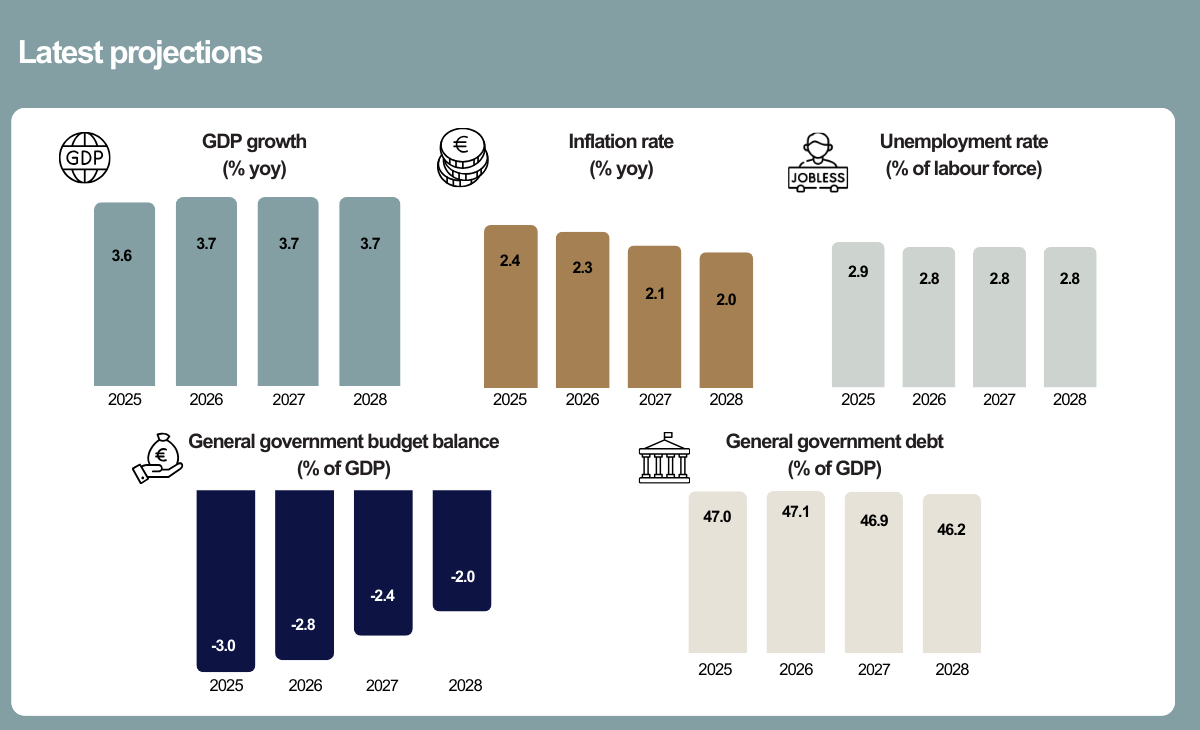
Economic growth forecast at 3.7% in the coming years
According to the Bank's latest forecasts, Malta's real GDP growth is set to remain stable at 3.7% over 2026-2028. Compared to the Bank's previous projections, the outlook for GDP growth over this period remains unchanged.
Growth over the projection horizon is expected to be led by private consumption, which is projected to continue to grow at a brisk pace, in part supported by recent changes to income tax bands. Net exports are also projected to contribute positively to GDP growth over the forecast horizon, driven by trade in services. However, this contribution is set to be smaller than that of domestic demand.
Employment growth is expected to moderate gradually to 2.3% by 2028. The unemployment rate is forecast to edge down to 2.8% from this year.
Wage growth is expected to remain strong but is set to moderate throughout the projection horizon as labour market tightness is set to ease.
HICP inflation is projected to stand at 2.3% in 2026, reflecting a decline in services inflation. Overall inflation is expected to ease further to 2.1% in 2027 and 2.0% in 2028, driven primarily by lower services inflation. Meanwhile, HICP excluding energy and food is also projected to decline and reach 1.9% in 2028. Compared to the Bank's previous forecast publication, overall HICP inflation is left broadly unrevised throughout the projection horizon.
The general government deficit-to-GDP ratio is projected to decline steadily over the forecast horizon, falling from an estimated 3.0% in 2025 to 2.8% in 2026 and 2.4% in 2027, before narrowing further to 2.0% by 2028. The general government debt-to-GDP ratio is expected to reach a peak of 47.1% in 2026, before easing to 46.2% by 2028. Compared with the Bank's December projections, the deficit-to-GDP ratio between 2026 and 2028 has been revised down by around 0.1 percentage point of GDP in each year.
Risks to activity are broadly balanced. Downside risks largely emanate from possible continued weakness in the international economic environment as well as elevated geopolitical uncertainty. On the other hand, employment and wages could exhibit even stronger dynamics than envisaged, especially in the medium term. This would result in higher private consumption growth and thus raise output growth more than envisaged.
Risks to inflation are slightly tilted to the upside over the projection horizon. Upside risks to inflation could stem from the persistence in services inflation. Food inflation could turn higher than expected in the presence of adverse climate effects. Having said this, some downside risks remain, particularly arising from the re-routing of exports from competitor countries to the EU and heightened competitive pressures in markets targeted by tariffs. Additionally, a renewal of trade tensions between the US and its trading partners could amplify uncertainty and further dampen global growth, putting more downward pressure on imported inflation.
On the fiscal side, risks are deficit-increasing. These predominantly stem from the possibility of slippages in current expenditure, such as higher-than-expected spending on energy support measures should commodity prices exceed assumptions, as well as wage-related outlays. These risks are partly mitigated by the likelihood of additional revenue windfalls.
This publication includes two boxes. The first box provides an analysis of developments in real wages in Malta during the recent global high-inflation period. The second box looks at the recent dynamics in food inflation.
More details on the Bank's latest projections can be found here.
Back to Archive