News - News Releases 2026
20/11/2026 20:30:00
Governor Demarco warns against complacency regarding economic transformation at IFS Dinner
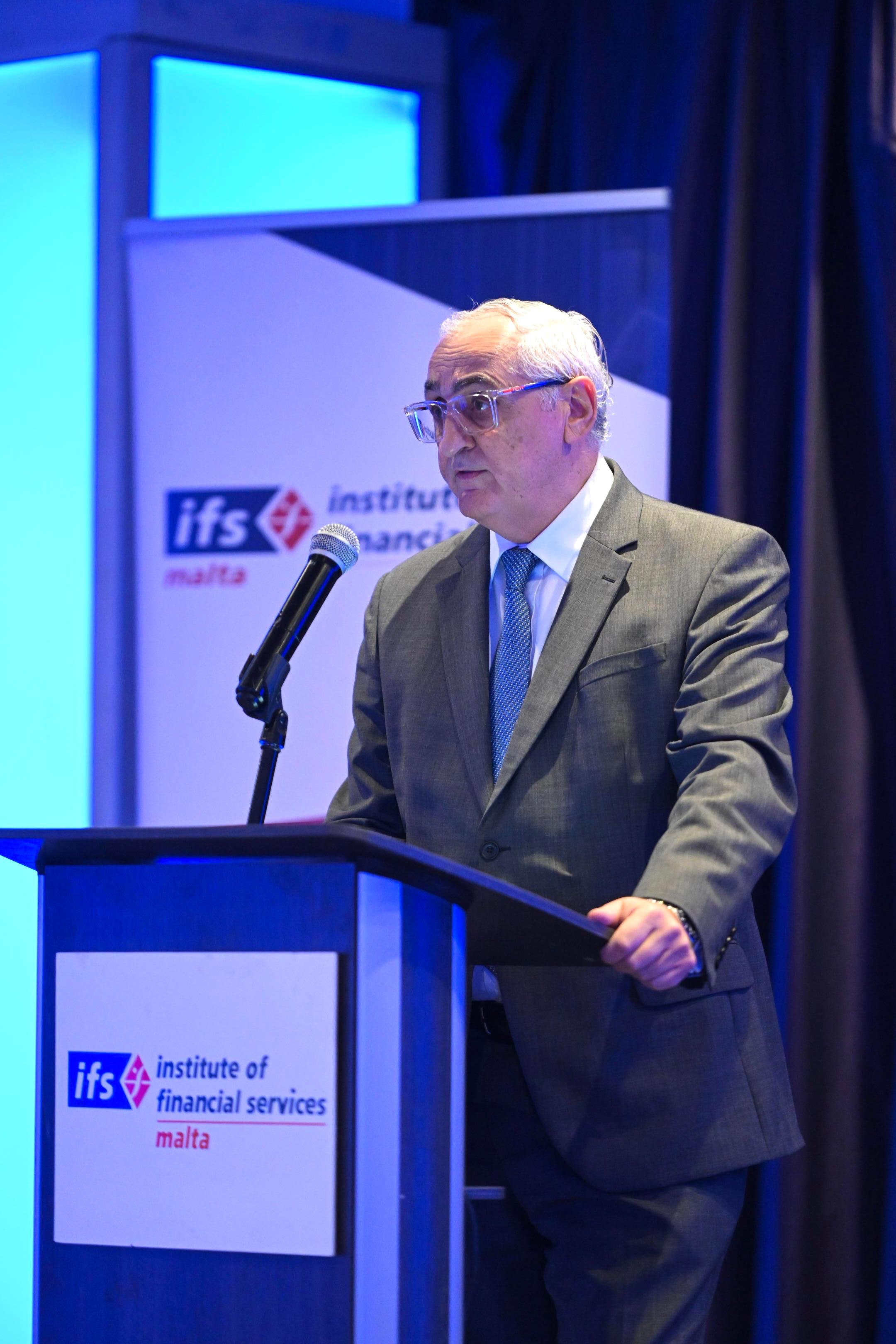
Speaking at the annual Institute for Financial Services Dinner, the Governor highlighted the persistence of elevated global uncertainty, following a series of events in the post-pandemic period, that upended energy markets and increased inflation risks, which are also generating social unrest.
While Government's stable energy price policy had shielded households and businesses, Mr Demarco stressed that "being shielded does not mean that our country is insulated from or unaffected by such global events." Higher import and transport costs, weaker foreign demand, and energy support costs still affect local inflation, economic growth, public finances, and the country's balance of payments.
Nevertheless, Malta had shown considerable resilience, with growth remaining robust, a surplus in the balance of payments, sufficient fiscal space, and a sound financial system.
But the Governor warned against complacency. Looking ahead, he sees there is nationally a growing consensus that Malta needs to rely less on workforce expansion and more on productivity-led growth by the private sector through smarter investment to improve production processes, and to engage in less labour-intensive activity, which would be aligned with recent fiscal measures designed to substitute labour with capital.
Technology, including artificial intelligence, could help in this economic transformation process. However, "buying new tools does not, by itself, increase productivity". Changes in work practices and investment in reskilling were also needed, accompanied by a strong social safety net to assist potential casualties.
Sound public finances and investment in transport, energy, water, waste management and digital connectivity were also essential for the productivity agenda. The Governor argued that while Malta's fiscal position remained sound, broad and open-ended subsidies impact public finances, requiring hard fiscal choices, reminding that subsidies should be "timely, targeted and temporary", though he called for great care in crafting exit strategies.
A productive economy also needs a sound and resilient financial system. Although domestic banks remain well capitalised, highly liquid and profitable, with sound asset quality, Mr Demarco warned against complacency as a "business model that today may be safe and profitable, does not necessarily mean that it remains fit for Malta's future needs."
Bank credit was outpacing GDP, with mortgages and lending to construction, real estate and accommodation accounting for almost three-quarters of resident lending. Such concentration in bank lending and the capital market is not in tune with the desire for a more digital and less labour-intensive economy.
Mr Demarco reaffirmed the Bank's loyalty to its mandate of both price stability and safeguarding financial stability, which require disciplined credit standards and borrower-based measures that protect lenders and borrowers from excessive leverage. The Bank remained ready to act within its mandate to foster incentives for the financial sector to finance Malta's economic transformation.
He concluded that while Malta is "currently navigating a very turbulent international environment", it is "starting from a position of strength in economic resilience, fiscal space, and soundness of the financial system". While this does not mean that the status quo remains an optimal choice, it neither implies that a radical revolution to the Maltese economy is needed.
Read the full  speech.
Back to Archive